
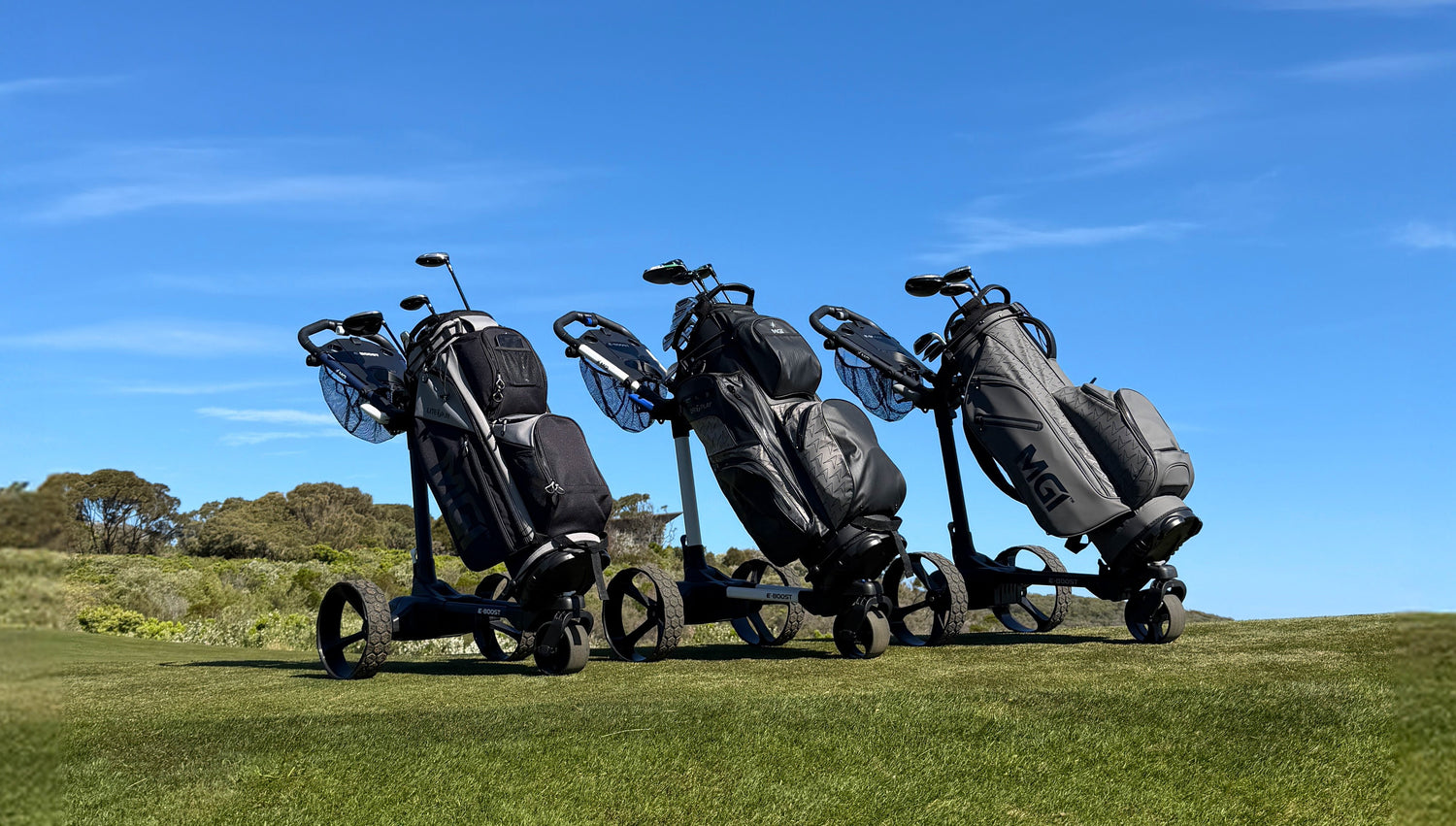
There's tension at the heart of modern walking golf.
On one side: the desire to walk, to stay connected to the course, to experience golf the way the game was meant to be played on foot, strategizing from ground level and staying engaged with every step.
On the other side: the reality of fatigue. Hills. Heat. The back nine. The year you turn 45, or 50, or 55. The desire to have help, to make walking sustainable, and the resistance to spending an evening icing your knees. For decades, golfers thought these two things were mutually exclusive. You either walked and toughed it out with no help, or you rode and gained comfort while losing connection to the game.
But that's not quite true anymore.
Today, golfers have options. The choice between a traditional walking golf cart, an electric push cart, and a hybrid "push cart with a kick" is more nuanced than most people realize. This guide breaks down the real differences, what each one is actually for, and how to figure out which one is right for your game and your long-term golf life.
Three Versions of "Walking Golf With Help"
1. Walking Golf Cart (Traditional Push Cart)
A traditional walking golf cart is fully manual. You push it. Your legs drive the motion. The cart is a mechanical frame, wheels, handle, and maybe a brake. Nothing electronic, nothing motorized.
Walking with a traditional push cart is just that: walking. You're connected to the course and staying in the game, but you're working. The trade-off is obvious, and for many, it’s a deterrent.
2. Push Cart With a Kick (Hybrid Walking Cart)
A push cart with a kick, like MGI's E-BOOST, is a different category. It's a traditional push cart with an optional powered assist that activates when you press a button.
Most of the time, you push it like a normal cart. When you hit a hill, when fatigue sets in, or when you want help, you press the kick button and the cart powers forward.
You're still in the game and walking the course. The cart is just helping take some of the load.
This is fundamentally different from a full electric push cart. With a kick assist, you're choosing when to activate power. You're the primary operator. The cart supports you when needed and stays out of the way when it’s not.
3. Electric Golf Push Cart (Full Electric)
A full electric golf push cart is a motorized device that handles most or all of the pushing work for you.
Different models work differently. Some require you to steer while the motor does the work. Some follow you remotely. Some include app connectivity and distance tracking. But the common thread is the same: the motor is doing a significant portion of the work.
Electric push carts typically feature:
- Battery-powered motors
- Remote control (sometimes with app)
- Advanced braking and downhill control
- Speed management and distance features
- Ranges of 36+ holes per charge
- Price tags of $800 to $3,000+
The benefit of this model is obvious: maximum powered assistance.
However, the cost is also obvious: more money, more complexity, and more technology to manage.
The Real Difference: Agency and Intent
The real difference between these options is who's in control. With a traditional push cart, you control everything. You push, you navigate, you manage your fatigue, and the cart is a tool.
With a push cart with a kick, you decide when to use assistance. You’re walking, pushing, and in the game, but you have the option to get help when you need it.
With a full electric push cart, the machine is doing a significant portion of the work, and you're managing it. You're steering, adjusting speed, and keeping track of battery and features.
None of these is objectively better. But they are very different experiences, and the right one depends on how you want to walk the course.
Comparing the Three: Side-by-Side
|
Factor |
Push Cart |
Push Cart With a Kick |
Electric Push Cart |
|
Who Controls Power |
You (manual) |
You (button-activated) |
Machine (motorized) |
|
Walking Experience |
Pure walking, full engagement |
Walking with optional assist |
Less walking, more device management |
|
Physical Effort |
Moderate |
Medium (push + button) |
Low (motorized assist) |
|
Course Connection |
Maximum |
High (still walking) |
Moderate (managing device) |
|
Price |
$$ |
$$$ |
$$$ to $$$$ |
|
Complexity |
Minimal |
Simple (push + button) |
High (remote, battery, app, etc.) |
|
Technology |
None |
Minimal (kick assist) |
Extensive (GPS, remote, tracking) |
The Decision Framework: Five Questions
If you're considering a change, it helps to step back and look at how you actually play.
These questions aren’t about finding the “best” option, but about understanding what kind of support makes sense for your game.
1. How often do I play?
Frequency matters more than most golfers realize.
- Fewer than 15 rounds per year: physical strain tends to be minimal
- 15–25 rounds: fatigue becomes more situational (terrain, weather, pacing)
- 25+ rounds: cumulative wear starts to factor into the experience
The more you play, the more small inefficiencies add up over time.
2. Do I want to stay fully manual, or introduce assistance?
This is less about ability and more about preference.
Some golfers value the physical engagement of pushing for all 18 holes. Others are open to reducing effort in specific situations, especially on hills or late in the round.
There’s no right answer here, just different ways to approach the walk.
3. How comfortable am I with technology?
Different setups require different levels of interaction. Manual and hybrid options tend to be more intuitive, while fully motorized systems often involve remotes, speed control, and battery management.
The right fit depends on how much you want to think about your equipment during the round.
4. What kind of courses do I typically play?
Course conditions play a significant role.
- Flatter courses place less demand on the cart
- Rolling or uneven terrain increases the need for control and stability
- Steep or consistently hilly layouts introduce sustained physical effort
The more demanding the course, the more noticeable the difference between setups.
5. How am I thinking about the long term?
For many golfers, this is where the decision becomes clearer.
If walking is something you want to continue doing consistently over time, it’s worth considering how your setup supports that — not just today, but years down the line.
The Trade-Off: Walking vs. Assistance
Every setup comes with trade-offs.
A traditional push cart keeps you fully engaged in the walk. It’s simple, consistent, and requires no adjustment. But over time, especially with frequent play or challenging terrain, it can become physically demanding.
At the other end, fully electric carts reduce most of that strain. They handle the movement for you, which can make longer or more difficult rounds easier to manage. At the same time, they shift your role slightly. You’re guiding the cart rather than pushing it.
Between those two approaches is a middle ground that introduces assistance without fully replacing the act of walking. For many golfers, the decision is about deciding which trade-offs they’re most comfortable with.
What’s Right for Your Game
There isn’t a universal answer.
Some golfers prefer the simplicity and consistency of a traditional push cart. Others look for ways to reduce strain while staying engaged in the walk, and some prioritize minimizing effort as much as possible.
Each approach reflects a different way of experiencing the game. What matters most is finding a setup that allows you to stay comfortable, stay focused, and continue playing the way you want to play.
